|
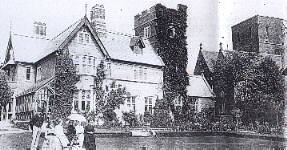
The Grange, is a listed Grade 1 building of great historic and architectural value. Pugin said it was built with 'not an untrue bolt or joint from foundation to flagpole'. He completed it in 1850 only two years before his death. It is constructed of light coloured brick with stone dressings under a slate roof, with a look out tower from which Pugin scoured the Goodwins for ships in distress.
The house is built with an expressed viewpoint. In comparison with the uniformity of Regency houses. With Pugin's houses it's possible to see from the outside where the staircase is and what the rooms where intended to be used for. The chimneys rise boldly upwards and the lightning conductors are all patterned with a P. Pugin could be described as an early functionalist. |
|
![]() |
Looking at the house from the garden, the downstairs bay fronted window, was Pugin's library. From this room came all the designs for the Houses of Parliament. The two flat fronted windows to the right in the photograph above are the dining room.
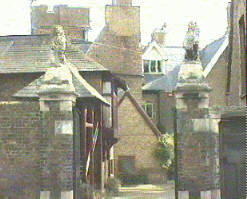
The entrance is through large wooden gates with stone heraldic lions from Pugin's coat of arms on the gate posts added by Edward. They lead into a cobbled driveway with the Cartoon room on the right and St. Edward's on the left. The front door of the house is through a glass covered walkway, added by Edward as was the library on the right. The rooms on the garden-side face the sea. There are five bedrooms on the first floor and a bathroom. John Hardman Powell's bedroom with a cosy fireplace was in the tower, under the castellated top. |
![]() |
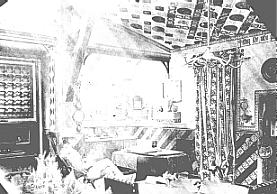
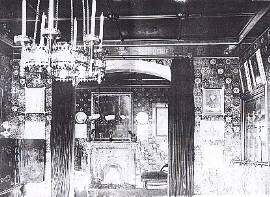
The picture on the left is the dining room, as it was in 1935, eighty three years after Pugin's death, still with its gothic wallpaper.
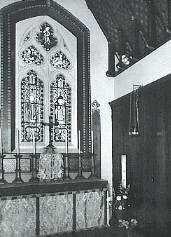
On the right is a picture of the small chapel in the house for private worship. The ceiling is blue with gold stars, the window is believed to be by W. Wailes. There is a small fireplace, Pugin did not think you could pray unless you were comfortable. Pugin's original house is neat and compact. Edward's alterations and additions made the house more spacious for an ever growing extended family. |
|
![]() |
The galleried hallway is double height, on the ground floor to the right is the drawing room which leads to the library. The dining room and the chapel lead off the hall to the left. The kitchen area is opposite the dining room.
In 1904 the house was struck by a thunder bolt demolishing part of the roof and rooms beneath. The two gabled windows destroyed were made one and more space was provided internally. The house was occupied during the second world war by Canadian troops. After that it became a prep school and then fell into private hands and neglect. However the house retains a hint of its previous life, that bustled with family activities, visitors and as home for one of the Victorian era's most hard working, dedicated men. |
|